
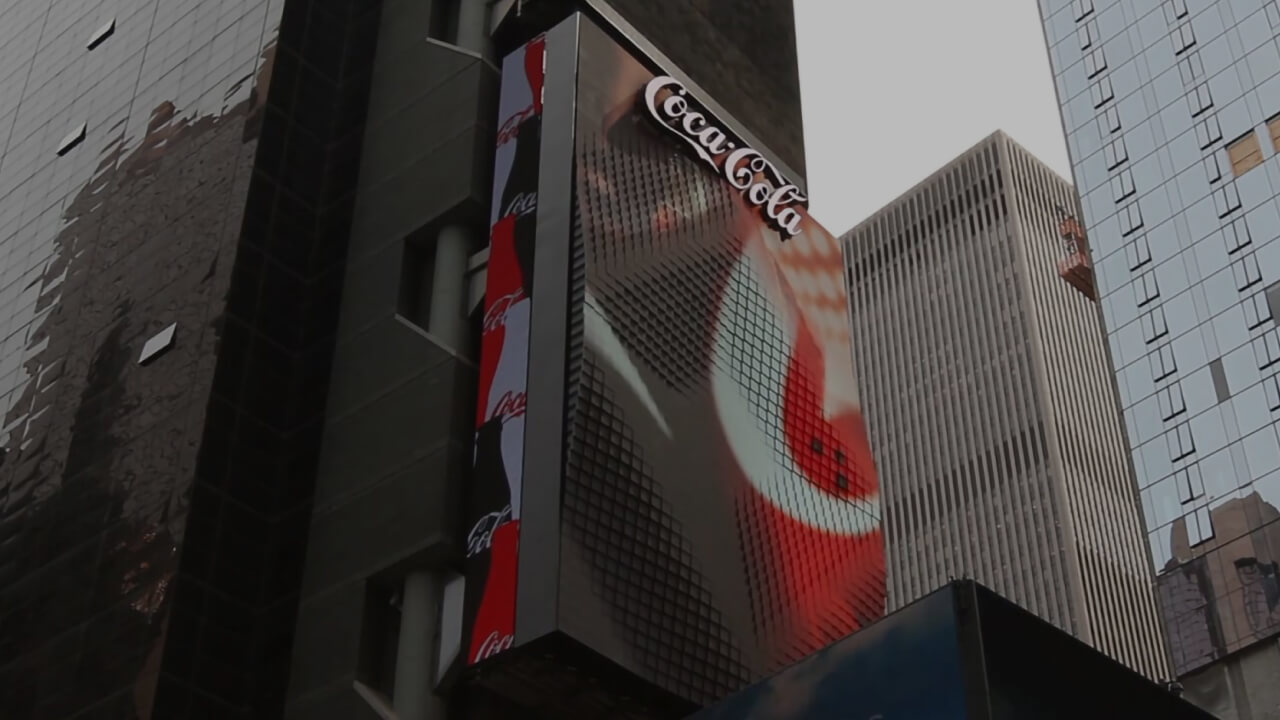
Your client has just sent you a brief. Somewhere in it are the words “3D effect” or “like that Coca-Cola screen in Times Square.” You know what they mean. The question is whether you know what the hardware needs to deliver it, and whether the screen you’re about to specify can actually do the job.
Why anamorphic LED is suddenly everywhere
Anamorphic LED, displays that create the illusion of three-dimensional content without glasses or special viewing equipment, has crossed from novelty into expectation. What started as a handful of high-profile brand activations on Times Square and the Las Vegas Strip is now showing up in retail briefs, venue upgrades, and DOOH tenders across the UK and Europe.
The driving force isn’t technology for its own sake. It’s shareability. A well-executed anamorphic display stops people in their tracks, gets filmed on phones, and circulates on social media long after the campaign ends. Brands have noticed. Budgets are following. And integrators are receiving briefs that include “3D-capable” as a specification requirement without always understanding what that means for the hardware conversation.
Not every LED screen can do this well
Here’s what most briefs don’t say out loud: anamorphic content is only as good as the hardware running it. And not every LED display is built to deliver it.
The illusion depends on two things working together, content engineered for a specific viewing angle, and a display that can reproduce it with enough precision that the effect holds. Pixel pitch, brightness uniformity, and refresh rate all determine whether the 3D content looks immersive or just slightly off. Corner transitions on a wrap installation have to be seamless, any misalignment between faces breaks the illusion immediately. Brightness needs to be high enough for daylight environments without creating hotspots that flatten the effect.
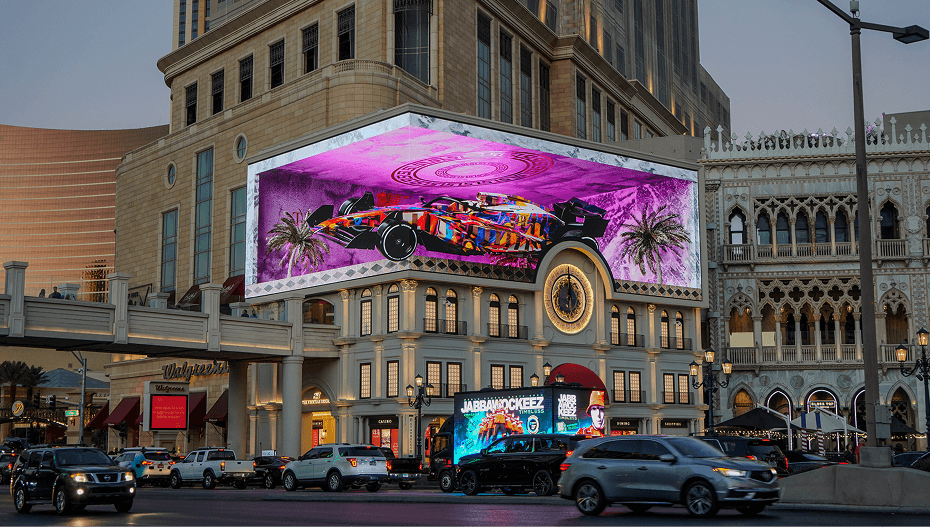
At the Venetian Resort in Las Vegas, 430 square metres of LED wraps three sides of the iconic Clock Tower. The anamorphic content runs continuously, in full desert daylight, visible to pedestrians and broadcast cameras simultaneously. That’s not a content challenge, it’s a hardware challenge. The spec has to be right before a frame of content is ever created.
What to get right in the specification
Three things determine whether an anamorphic LED installation actually delivers on the brief.
Pixel pitch. Fine pixel pitch is not optional for close-to-medium viewing distances. A display that looks sharp running standard video content will show its limitations with anamorphic content at shorter viewing distances. Get the minimum viewing distance calculation right before you specify.
Corner architecture. Multi-face and wrap installations live or die on the corner join. How two faces meet, how panels are engineered to turn a corner without a visible gap or brightness drop, is a hardware decision, not an installation decision. Ask about it before the screen ships.
Brightness and uniformity. High peak brightness matters for outdoor environments. Bauer Digital’s LED systems deliver up to 10,000 nits for high-impact outdoor use, with adaptive brightness sensors for day and night balance. But uniformity across the full surface matters just as much. A display with poor calibration consistency will look worse running anamorphic content than a lower-brightness display with tight uniformity tolerances.
Anamorphic LED is no longer a showpiece format. It’s a mainstream client ask, and the integrators who can specify for it confidently, hardware first, content second, are the ones who will win these briefs.