
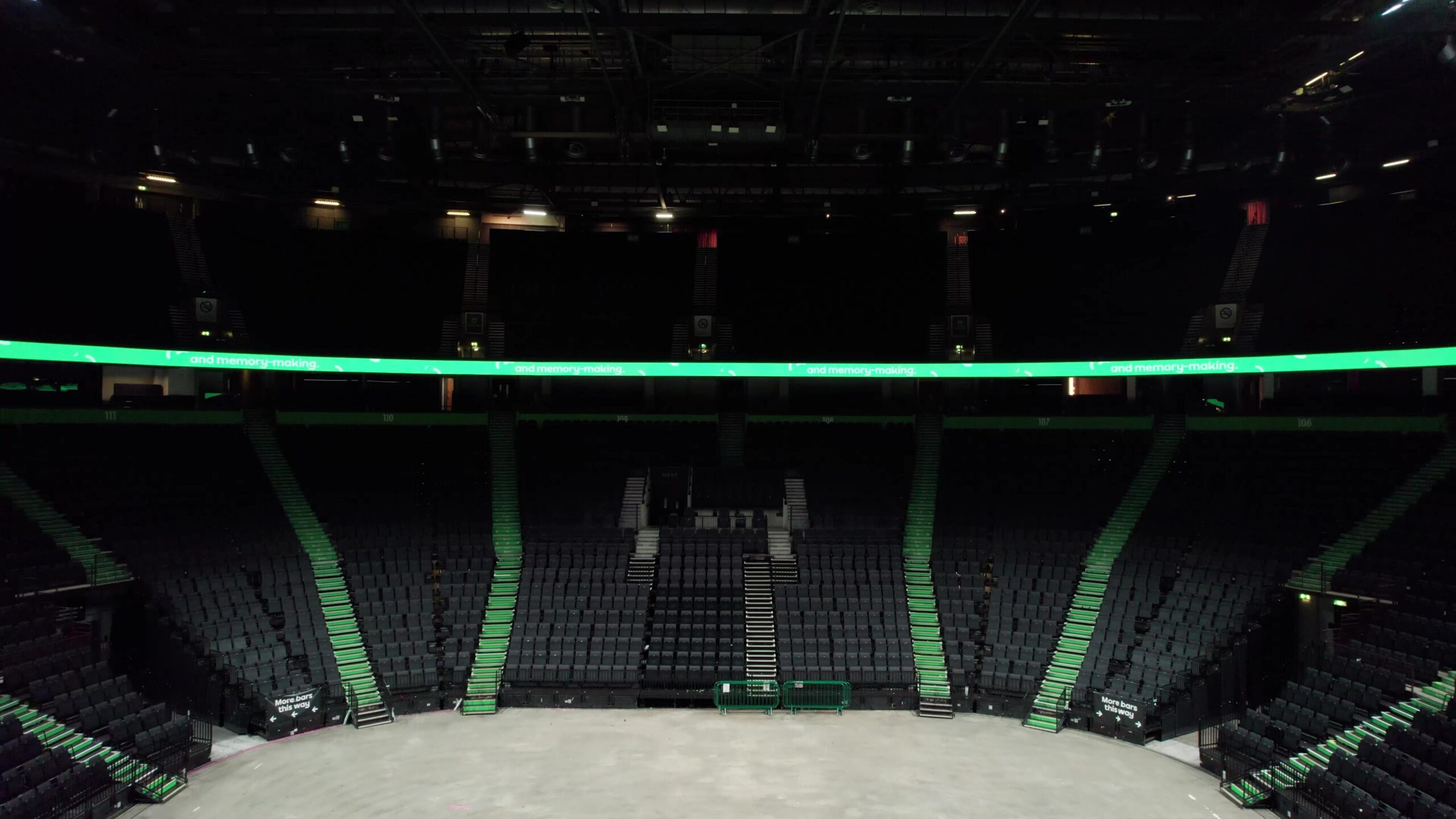
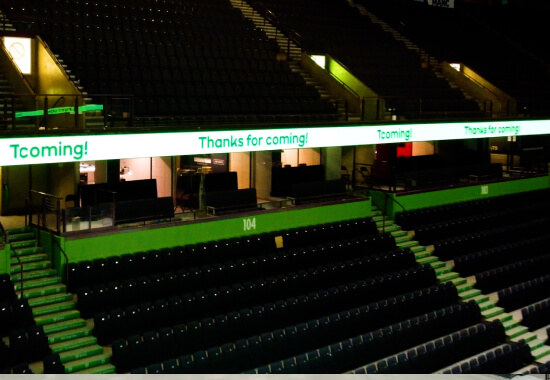
Tickers and ribbons aren’t photographed. They’re read.
By every fan in the bowl. Across 90 minutes. On every wide shot, every stoppage, every atmosphere build. That makes them, quietly, the highest cumulative-attention screens in the venue. Not the centerhung. Not the end-zone boards. The ones running along the fascia, cycling scores and sponsor messages and clock data on a loop.
And yet they’re routinely the screens specified by a different vendor, on a different product line, on a different timeline to everything else in the brief. That separation is where most stadium-tech projects start to drift, and where they keep drifting, for years.
The problem with specifying them separately
Tickers and ribbons are often treated as a procurement afterthought. They come in under a different budget line, on a different sign-off, sometimes months after the main board has already been selected. By the time anyone asks whether they’ll integrate cleanly, the answer is usually: not quite.
The result is two parallel hardware ecosystems running in the same venue, calibrated differently, maintained differently, and failing on different schedules. Individually, each might perform fine. Together, they fight.
What integrators should flag in the first conversation
If you’re being briefed on tickers and ribbons as a separate scope, these are the questions worth asking before anything gets specified:
Colour calibration against the main board. Different product lines drift apart on different timelines. If the ribbon and the centerhung aren’t specified to calibrate against each other, they’ll look mismatched inside a season.
Thermal profile under continuous load. A ribbon running content for 90 minutes uninterrupted has a different thermal brief to a centerhung running interrupted playback. If the hardware isn’t rated for it, you’ll see it in the failure data.
Data architecture. Is the ticker hardware reading from the same system as the main board, or running on its own controller? One integration means one failure surface. Two separate controllers means two, and twice the points of failure on matchday.
CMS compatibility. Hardware locked to a single platform decides what your integrator can work with downstream. Specifying CMS-agnostic hardware at the outset preserves flexibility; specifying locked hardware trades that flexibility for a cost saving that rarely holds over a 10-year asset life.
The brief that prevents 15 years of problems
The biggest screens in the venue get the press release. The tickers and ribbons get the matchday, quietly, continuously, and in front of more cumulative eyeballs than almost anything else in the bowl.
They deserve the same engineering rigour as the main board. Not the same budget. The same rigour.
Specify them together, on the same brief, against the same integration standards, or accept they’ll fight each other for the next 15 years.
Built with Precision. Engineered to Perform.