
Every LED install looks the same on day one.
Brand new panels. Calibrated to the broadcast brief. Bright, sharp, evenly distributed across the assembly. Whatever the vendor, whatever the price point, year one almost always works.
The interesting variation arrives somewhere between year three and year five. That’s when calibration drift starts showing up. Pixel clusters fail in the hottest panels. Power redundancy that was assumed turns out to be a single point of failure. Spare panels can’t be sourced to match the colour gamut of the rest of the install. The vendor has restructured, or stopped supporting that product line, or sold the IP.
For integrators specifying LED in 2026, the install isn’t being designed for 2026. It’s being designed for the conditions it’ll be in by 2030, 2034, 2040.
That’s an engineering question. Not a procurement question.
Here are the five engineering decisions that decide what an LED install looks like at year fifteen, taken at spec, before procurement.
1. Pixel pitch tuned to seating geometry, not catalogue spec
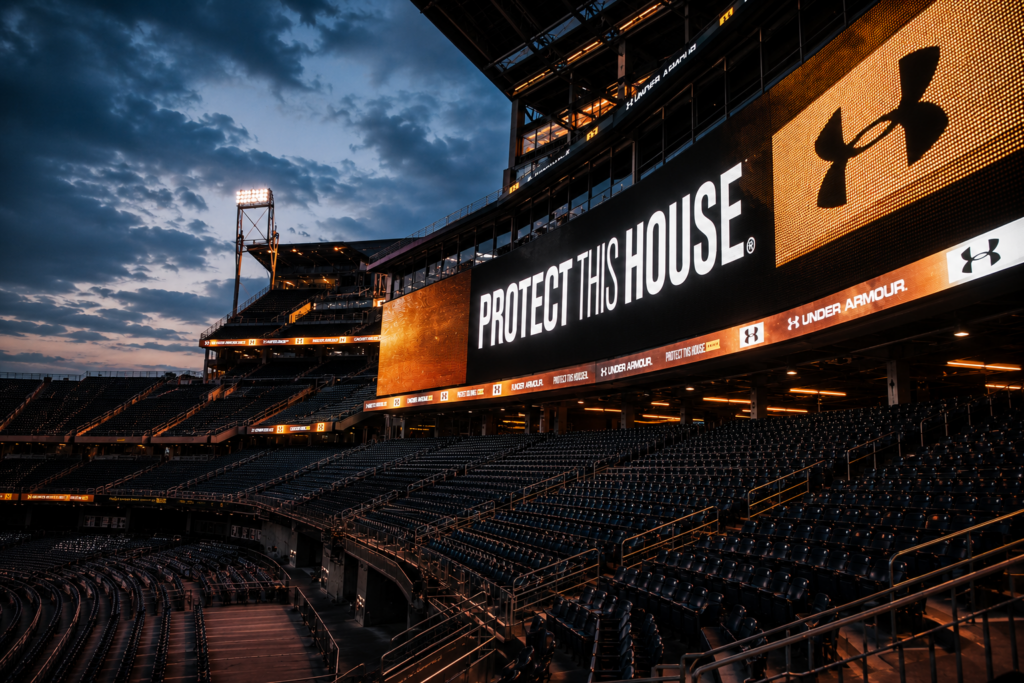
The pitch number in the brochure is the pitch optimised for an even broadcast viewing distance. The pitch in the venue is what’s actually required for the closest seat in the lower bowl and the farthest seat in the upper rim. The difference shows up in two places: as soft content on slides at the close distance, and as compressed content on slides at the far distance. The first decision the engineering brief makes is to ignore the brochure pitch and start from the geometry of the seating bowl.
2. Cooling spec written against real-world ambient, not brochure ambient
The brochure ambient is the temperature that ensures the warranty stays valid. The real-world ambient at the install site is whatever the venue actually runs at, 35°C in a Texas summer, 5°C in a Seattle winter, condensation cycles in a UK arena that the brochure doesn’t model. The cooling spec needs to be written backwards from the real ambient. Most aren’t.
3. Modular tile architecture, for service, not just for spec sheet
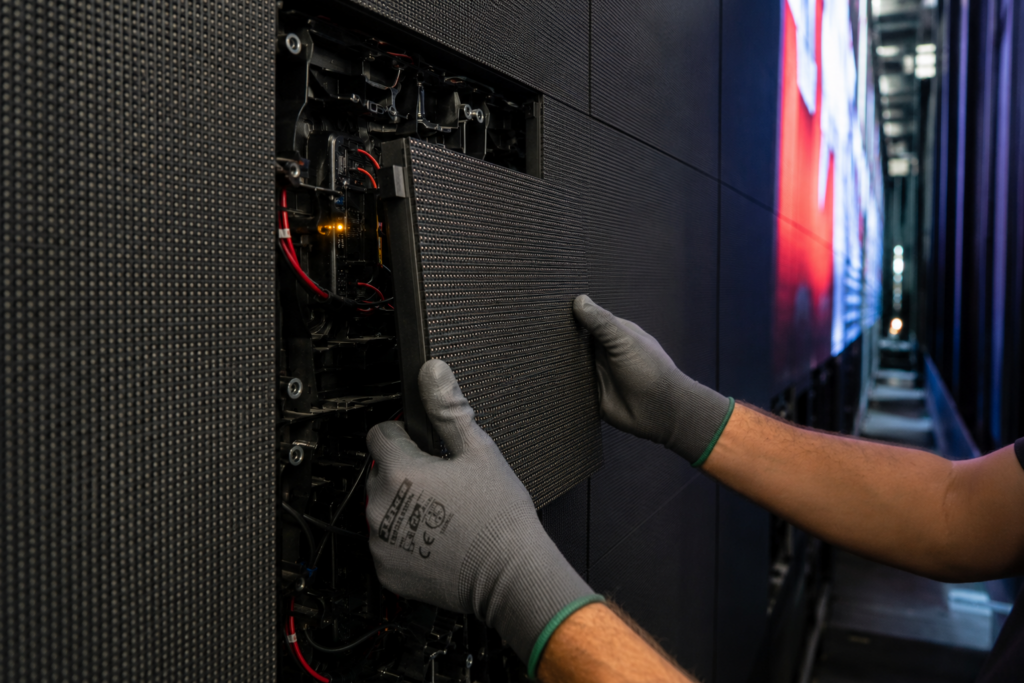
Every LED install advertises ‘modular’ on the brochure. Few are actually serviceable as modular installs three years in. The test is what happens when one tile fails on a Saturday: is it a single panel swap, or is it a six-week project? Front-serviceable cabling, single-tile replacement as the unit of repair, and a documented spare-parts inventory at the manufacturer are the three structural decisions that separate them.
4. CMS integration depth
The CMS layer is what turns a fleet of screens into a system. Most stadium-tech projects have a predictable failure mode here, different products on different CMS platforms, sync drift, two-vendor escalation chains when something goes wrong, content takeover that lands on three screens and misses four. The CMS spec needs to be drafted before the panel spec.
5. Lifecycle commitment from the manufacturer
The most overlooked structural decision. The manufacturer’s spare-part inventory commitment, product-line continuity, end-of-life pathway, and engineering support window. All easy to ignore in procurement. All easy to regret in year five.
Why this matters now
Bauer Digital is the exclusive UK and EU distributor for Yaham, one of the largest LED manufacturers in the world, with 120,000 m² of production capacity and 12,000+ installs across some of the most demanding environments in the industry.
The combination of Yaham’s manufacturing scale and Bauer’s UK engineering layer is what makes the five decisions above viable in practice, not just in theory. Manufacturer scale is the structural reason a Bauer install is reliable in year five, when most installs start to drift.
The procurement decision happens once. The engineering decisions decide what the install looks like for the next fifteen years.
Take the time to make them first.